

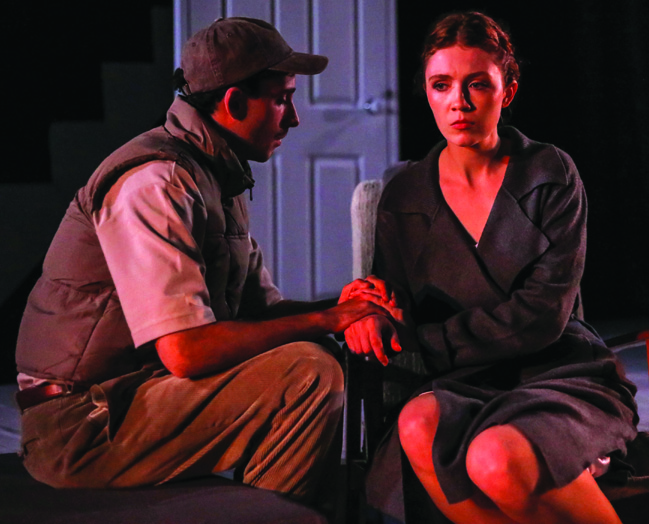
OBSERVER: Dial M For Murder
Frederick Knott’s Dial M for Murder is an unusual choice of a play to revive given its 1952 origin as a radio play and subsequent film.
Tony Wendice (Tyrie Aspinall) plots to kill his wife, Margot (Bridget Bourke), given her past relationship with the crime writer, Max Halliday (Leon Walshe).
Wendice persuades Captain Lesgate (Joshua Bruce) to strangle Margot but is himself despatched though Margot is framed for his demise.
The subsequent investigation by Inspector Hubbard (also played by Joshua Bruce) established her innocence because of an errant latch key.
Knott’s play is an old fashioned pot-boiler. The exposition of the scheme and some of the discourse comes across as a little dated today.
Walshe ultimately manages to inject an enthusiasm in his character when trying to promote his life-saving scheme.
Bruce is suitably relaxed in both his roles. The audience manages to accommodate the murderer and inspector as different entities but it is an inconvenient leap.
Bourke covers the range from masking her past relationship to being unfairly framed.
Aspinall’s delivery is not as comfortable as it might be, the mannered nature of an Englishman not yet second nature.
The open set (Jodi Hope) is suitable but for the need to secure the door frame more firmly. Most unusual and anachronistic is the director’s choice (Dean Drieberg) of upgrading the phone over the course of the play from a dial to a touch and, finally, mobile device that is a conceit gone wrong. The ‘Dial M’ of the title might be a giveaway here and, whatever message he hoped to impart, is lost in the incongruity of the change.
Foremost in the production is the internecine plot rather than any other social message. Wendice outlines his plan, Halliday’s solution is the plan again and Hubbard exposes the plan. Everything else is artifice.
Presented at Theatre Works.
Review by David McLean
Pictured: Leon Walshe and Bridget Bourke in Dial M for Murder.
Photo: Dave McCarthy