

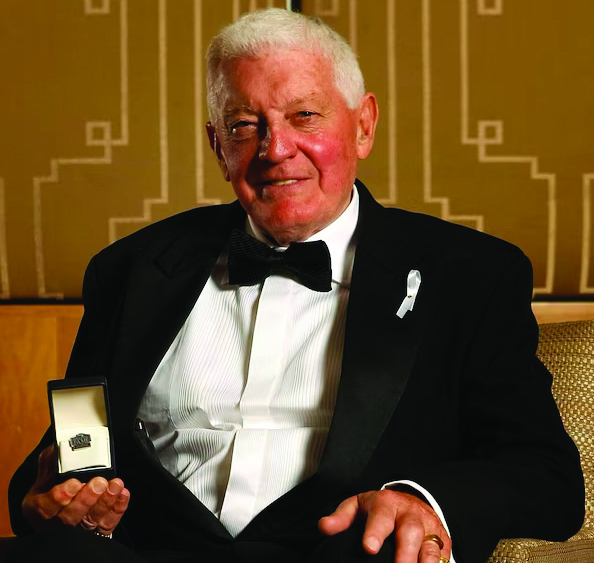
PEOPLE: Local MP’s tribute to Brian Dixon
Eildon MLA Cindy Mcleish paid tribute to the life of Brian Dixon, in an address to State Parliament:
“Brian Dixon led a life that most people can only dream of, and he did it exceptionally well, with great success on the sporting field and in his professional life,” Ms McLeish said.
“Brian was a man of great conviction and determination. He was a man of intellect who lived and breathed his values every day.
“He had many passions: his six children, his beloved Melbourne Football Club, the Liberal Party, health and fitness, and MND.
“Whenever I spoke to Brian he reminded me about the importance of the Life Be In It campaign and how it should be policy again because it has lived on so well.
“He always had ideas, and a lot of these ideas were about how to combine his passions. He would speak to me about being the president of the past premiership players association and how we could use that perhaps as a fundraising opportunity for one of his causes, MND.
“It did not matter what he was doing, Brian had ideas. He attributed his success to a number of factors: concentration, determination and courage on and off the field.
“It must be said that there were times when Brian could be a little bit difficult. As we have heard, he had humble beginnings. His father suffered poor health; at the time they were told he had a type of muscular paralysis which his family now believe to be MND, and that was a disease Brian’s late eldest son Anthony was also to suffer, hence Brian’s passion.
“Brian was an only child, and he had strong
memories of pushing his father around in a wheelchair. His father, as we have heard, passed away when Brian was 14, and he was raised by his mother Amy.
“He went to Melbourne High, and this was
a school he loved. He maintained a relationship with them all his life, and it was fitting that the choir sang at his state funeral.
“Now we come to his politics. People may have thought that Brian might have been aligned with Labor Party values, but he took a look at them and went, ‘Yeah, nah.’
“He had a look at the Liberal Party values and thought this was where he belonged: a party of aspiration, reward for effort, looking after those who needed looking after and, importantly, equality of opportunity, particularly around education.
“Brian was a true Liberal in Menzies’ fashion, determined to be progressive. He was moderate, socially conscious and very happy to have his opinion heard, always.
“Elected in 1964 – as we have heard, the same year as he won his fifth and last premiership – as the member for St Kilda.
“He could have won six premierships; however, he incurred the wrath of Norm Smith by playing in a game between the dentists and the commerce faculty at Melbourne University. That was something he was not supposed to have done, so he did not get selected for that grand final.
“He arrived at Parliament, where his passions and values were at play. We have heard his stance on capital punishment, and if you read his speech on that debate, he could not see why you would deal with violence with violence.
“He worked very collaboratively with opposition members to get that bill through the Parliament in a progressive Hamer Government.
“Remembering he was the member for St Kilda, and they have different types of activity – or they certainly had different types of activity there at the time – Brian was very keen to make a difference to the sex industry, and he did research by chatting with the sex workers to understand their safety needs.
“He thought that as this was the oldest profession and it was not going to go anywhere, those working in it should be safe, and he put a proposal forward to the Parliament, which you can find in the library, regarding prostitution and massage parlours.
“I want to read a couple of comments from here, because it was about controlling safety in prostitution and in massage parlours. This was of particular interest – the proposal followed the principles endorsed by the state Liberal Party, which in March 1979 passed the following resolution:
“That this State Council – emembering we are talking about a council moved at the state Liberal Party – recommends that there should be legislation to the effect that premises for the purpose of prostitution be able to operate only in non-residential areas and subject to stringent controls, and that thereafter more powers be made available for the control of prostitutes soliciting from the streets and utilising illegal premises for the purpose of prostitution.
“He put a very detailed paper to Parliament recommending that prostitution be permitted to function in massage parlours in the prescribed areas in Victoria subject to controls and that existing sanctions against street prostitution be retained.
“He was very keen that everybody should be protected and safe in their workplace. I am sure that executive director Carolyn Gowers and her team from Project Respect would be really pleased to have seen what Brian put forward in 1979.
“Combining his passion for politics and sport, Brian was able to leave Parliament or his ministerial office to scoot off to football training.
“As has been said, imagine if we had a minister for sport who did the same at the moment – leave this place and scoot off to football training.
“It was as the Minister for Youth, Sport and Recreation where Brian made his biggest impact. As I said earlier, Brian was an intellect. He was an ideas person who wanted to make a difference, and he believed his role as a minister was to make a difference.
“He was the Minister for Youth, Sport and Recreation from May 1973 to April 1982, and racing also came under that portfolio.
“His thinking was some of the best in the world; he was a leader, and he was very serious about the health of the country.
“Brian was fit. He was a footballer, but he did run 10 marathons – that classifies him as a Spartan. He knew a lot of the programs that the government had were aimed at already healthy, fit people, and he thought, ‘We need
to do something different, a different approach to get people off the couch.’
“This was the genesis of the Life Be In It campaign, which was rolled out very successfully here, interstate and overseas.
“Like all good politicians – you know, kids do get rolled out occasionally – he used his kids in the ads for Life Be In It and for safety – helmets for skateboarding and biking. He had kids running up hills, as well as doing all of the regular stuff like letterboxing.
“I want to reflect on his role as a minister within the department. I spoke to a couple of people who worked for him at the time. The staff loved him and said he treated people very well.
“Perry Crosswhite, who some people may know was an Olympian,said he was fantastic – ‘Brian had ideas’, which apparently was pretty unusual for ministers.
“He had so many ideas and that was infectious. The staff knew that if they too had an
idea it was given the light of day. No idea was bad. You could come and present an idea and it would be considered, so there was a buzz in the office and people wanted to come to work. “Other department members would come in and they would notice the feeling in the office of that buzz. Perry said it was exciting to come to work. They had a lot of young people.
“I want to talk also about Brian’s support for staff, because in 1980 there were the Moscow Olympics, and Malcolm Fraser had his view on what should be happening with the Moscow Olympics and whether people should boycott or not.
“Brian had a staff member – again, Perry Crosswhite – who was in the Australian basketball team, and it was going to be quite contentious whether Perry was given leave to go to the Olympics when Australia’s position was, ‘We’re not really sure that we want you to go.’ “Brian ignored the fact that Perry was away for six weeks, and when Perry came back and asked whether he was missed, Brian said, ‘Oh, have you been away? I hadn’t noticed.’ Perry thought that was an amazing support for him.
“We have heard about a number of initiatives that Brian drove, but some that we have not heard about are bicycle paths and trails. Brian had seen trails overseas and he wanted to introduce them in Victoria.
“He was pooh-poohed a bit in cabinet about them and it was seen as one of Brian’s crazy ideas, but he persisted, because at the time the only bike path was along the Yarra for the rowing coaches, and that was not really a way of everybody else keeping fit.
“He thought, again, that cycling helped people keep fit and it kept traffic off the road, so in typical style he did a publicity stunt that involved him taking some of the staff and the press through the city in some dangerous situations, detailing the need to have bike paths and trails.
“We have so many of these now, and this is because it is something that Brian initiated and drove. He had a lot of fights with the Board of Works about getting paths along the Yarra, but he persisted, and that city network of bicycle paths is here because of Brian.
“We have indoor sports facilities, something that we all take for granted now. In the early 1970s there
were hardly any indoor sports facilities or leisure centres, and Brian worked with local governments across the state to change this, from Poowong to Yackandandah, Croydon and across the city.
“I know Alexandra, not far from where I grew up, got a stadium, and I used to go up there and play basketball. It was a very big deal for country towns to have indoor facilities.
“These were funded through punting. Governments do not always like to hypothecate, but it was agreed that profits from racing could be diverted in this way, and indeed this is what happened.
“If you check out the 1979–80 annual report for youth sport and recreation, we can see that in the 1970s there were percentages of off-course turnover pumped into these facilities: 2 per cent of daily doubles, 2 per cent of trifectas and 4 per cent of quaddies were directed in this way. It was the early days of the TAB, which operated in 1961 as a state government agency, and this was under Brian’s portfolio. “So not only did he pursue indoor sports facilities but he supported country racing clubs and the city. Knowing that we needed international-standard facilities and events that were going to help Melbourne to be the sports capital and to be a destination, he began building them. Internationalstandard state recreation facilities were well on the agenda. “The state hockey centre at Parkville, with
a flash new synthetic surface, opened in 1980 or 81. I remember my first game on there; it was a very big deal. I think it might have been in 1982.
“Brian continued to have ideas. The 1979–80 annual report also talks about a sports house to be located in the metropolitan region where the administration headquarters of parent sporting associations could be housed in one building. In association with that the establishment of a Victorian Institute of Sport was under consideration.
“Brian drove so many initiatives that get lost because we have concentrated so much on the amazing success of the Life Be In It campaign.
“Later in life Brian settled in Jamieson. He had had a farm in and around Mansfield and settled in Jamieson and married Carmel, who he met at a Mansfield branch meeting.
“Brian put in so much locally. He donated; he taught footy at the local schools – it was something he believed in. He was really active in tennis, and in his late 70s he was still beating a lot of people on the tennis court – that competitive nature never died.
“He had parties. He loved his parties, and at parties the life games manual from Life Be In It would be rolled out.
“This saw the creation of human pyramids. There is a story of a party where he had a number of the Danihers up there as well, and they had the human pyramid, I have heard, four and five levels high.
“Brian always wanted to get things done. Father George, who came down as a celebrant from Mansfield and Jamieson, said Brian would always sweep the leaves at the front of the church on a Sunday up until a year ago so it looked good.
“He was very keen on helping out and was not so keen on those who did the wrong thing or did not do enough to support their communities.
“Brian and Carmel were the most amazing hosts. I do not know if it has been said that Brian liked parties and having a couple of drinks. At 5 o’clock every night Brian and Carmel would have a glass of bubbly and then a glass of red with their meal.
“As Brian’s health deteriorated the doctor advised Carmel to just water it down a little bit so he could still enjoy the glass of red, even though it was a little bit watered down.
“You would see Brian and Carmel power walking around town always or watching his daughter Judy, who was either playing or umpiring netball, and her daughters Amy and Jacinda as well.
“You would see Brian and Carmel come into the Mansfield Football Club and be their active supporters all the time.
“Brian and Carmel had a wonderful 22 years together. My condolences certainly go to Carmel, to Brian’s children Jenny, Judy, Jaimie, Jono and Bae and to their many grandchildren. He drank well from the cup of life.
“Vale, Brian,” Ms McLeish said.
Pictured: Brian Dixon. Photo: ABC News.